
COLLEGE OF NURSING

MA. CORAZON B. OSONGCO, RN
Master of Arts in Nursing
Doctor of Education
Dean, College of Nursing
Welcome to CEFI, College of Nursing! We are embarking on a career that stimulates mind and spirit, and which allows human beings to flourish. We are preparing nurses in today’s health care environment with theoretical and clinical placements, research, leadership and advocacy initiatives.
To make the nursing program more relevant and responsive, we have strengthened the curriculum with the integration of two other programs, the caregiving and medical transcription courses.
Collectively, as a vocation and as a profession, we give various opportunities from becoming a nurse we hope to become a caring, competent, and committed nursing professional and entrepreneur.
CONTACTS
Email Address:
Telephone Number:
(042) 710-2514
Course Prospectus:
COLLEGE OF NURSING ACTIVITIES

Allaurin, Top 3 in Midwifery Board Exam
CEFI cements its reputation anew as the home of….
Allaurin, Top 3 in Midwifery Board Exam
CEFI cements its reputation anew as the home of….
Allaurin, Top 3 in Midwifery Board Exam
CEFI cements its reputation anew as the home of….
Allaurin, Top 3 in Midwifery Board Exam
CEFI cements its reputation anew as the home of….
OVERVIEW OF THE DEPARTMENT
VISION
The College of Nursing envisions itself to be the center of learning in nursing education coupled with excellence in research and community service.
MISSION
The College of Nursing is committed to the holistic development of nursing students through a broad general education program and consistently updated nursing curriculum for responsible performance as citizens of the Filipino society, country, and global community.
GOALS
To meet its vision-mission, the college’s goals are:
-
- To develop nurses who exemplify dignity and integrity through adherence to truth and righteousness;
- To impart knowledge and skills in the nursing process that are essential in becoming critical thinkers who are also competent in health care delivery, communication and research;
- To instill in the students the value of compassion, caring, patience and sensitivity to the needs of every individual, and;
- To provide opportunities for the students’ growth and development vital in their future career direction (i.e. teaching, hospital work, community service or research).
COLLEGE OF NURSING LOGO:
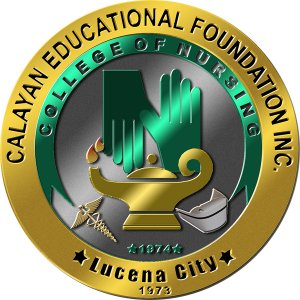
The nursing logo has two colors – green and gold. Green symbolizes preservation of life while gold depicts excellence in all school’s goals and objectives.
Encircling all nursing symbols (hands, lamp, cap, caduceus) is the institution itself. It encompasses the knowledge, skills and attitude deeply rooted in the teachings of the school, via its responsive and relevant programs.
The hands encompass SCHOLARSHIP. They are used to bring comfort to the needy. They depict compassion and competence in all nursing functions.
The nurse’s lamp depicts SERVICE. The light is a sign of dedication and commitment to all nursing endeavors. It is used to brighten patients’ lives –every man, woman, and child in her / his care.
The caduceus exemplifies the effective participation of the nurse in the medical team. It reflects achievements and opportunities for the nurse’s holistic growth and development.
BSN Curriculum
The BSN curriculum is a competency based curriculum whereby the knowledge, skills and attitudes of students are developed and enriched. The curriculum contents are relevant and responsive to the needs of students and their clientele. The BSN is a four-year program consisting of general education and professional courses. Professional courses begin in the first year and threads through the development of competencies up to the fourth year level. The program provides an intensive nursing practicum that will refine clinical skills from the first year level to ensure basic clinical competencies required of a beginning nurse practitioner (CHED Memo no. 14, series of 2009).
Based on the guidelines for the implementation of CHED Memo no. 15, series of 2017, the curriculum implements the “shift from competency based standards to outcomes-based education.
The BSN program aims to produce a fully functioning nurse who, upon completion of the program, demonstrates beginning professional competencies and shall continue to assume responsibility for professional development and utilizes research findings in the practice of the profession.
The Key Areas of Responsibility for which a nurse should demonstrate competence are: 1) Safe and quality nursing care, 2) Management of resources and environment, 3) Health education, 4) Legal responsibility, 5) Ethico-moral responsibility, 6) Personal and Professional Development, 7) Quality improvement, 8) Research, 9) Record Management, 10) Communication, and 11) Collaboration and Teamwork.
At the end of the first year, the students shall have acquired an understanding and awareness of themselves as an individual and as a member of the family, the community, and the world with emphasis on personal, societal and professional values, responsibilities, rights, and an awareness of physical, social and cultural milieu.
At the end of the second year, the student shall have acquired the holistic understanding of the human person as a bio-psycho-cultural being focusing on the concept of health and illness as it is related to the care of the mother and child in varied settings. The student shall be able to demonstrate the competencies under the 11 key areas of responsibility.
At the end of the third year, given actual clients / situations with various physiologic and psychosocial alterations, the student shall be able to demonstrate the competencies under the 11 key areas of responsibility.
At the end of the fourth year, given actual clients / situations, the student shall be able to demonstrate competencies in all the key areas of responsibility.
*The Caregiving program is integrated in the BSN I and II of the curriculum. The Medical Transcription is integrated in the BSN III program. Nursing students will have the opportunity to take the NC II examination after having completed the requirements.
PROGRAM EDUCATIONAL OBJECTIVES
-
- are gainfully employed in various healthcare facilities;
- can apply acquired knowledge and skills in various areas of specialization utilizing the nursing process;
- are engaged in evidence-based practice researches for the advancement of nursing profession;
- can speak with ease and confidence in organizational communication;
- are engaged in various trainings, seminars, conferences and graduate programs as a tool for career advancement;
- and can demonstrate safe nursing practice with social responsibility, just and humane regards to people and commitment to service.
PROGRAM OUTCOMES
-
- Apply knowledge of physical, social natural and health science and humanities in the practice of nursing.
- Provide safe, appropriate and holistic care to individuals, families, population, group and community utilizing nursing process.
- Apply guidelines and principles of evidence-based practice in the delivery of care.
- Practice nursing in accordance with existing laws, legal, ethics and moral principles.
- Communicate effectively in speaking, writing and presenting culturally-appropriate language.
- Document to include reporting up-to-date client care accurately and comprehensively.
- Work effectively in collaboration with inter-, intra- and multidisciplinary and multi-cultural teams.
- Practice beginning management and leadership skills in the delivery of client care using a systems approach.
- Conduct research with an experienced researcher.
- Engage in lifelong learning with a passion to keep current with national and global developments in general, and nursing and health developments in particular.
- Demonstrate responsible citizenship and pride of being a Filipino.
- Apply techno-intelligent care systems and processes in health care delivery.
- Adopt the nursing core values in the practice of the profession.
- Apply entrepreneurial skills in the delivery of care.
HISTORY OF THE DEPARTMENT
Calayan Educational Foundation, Inc. is one of the private educational institutions of Lucena City. It is a non-stock, non profit institution of higher learning that was founded by Drs. Emeterio and Josefina del Villar Calayan in 1973. It pioneered para-medical courses in Quezon Province, starting with the Midwifery Program in 1973. The Graduate in Nursing (GN) program opened in 1974. Eventually, the Bachelor of Science in Nursing was granted government recognition in 1985.
In 2009, the College of Nursing was granted Level I Accreditation by the Philippine Association of Colleges and Universities Commission on Accreditation (PACUCOA). In 2012, it was granted Level II Re-Accreditation.